Students / Researchers
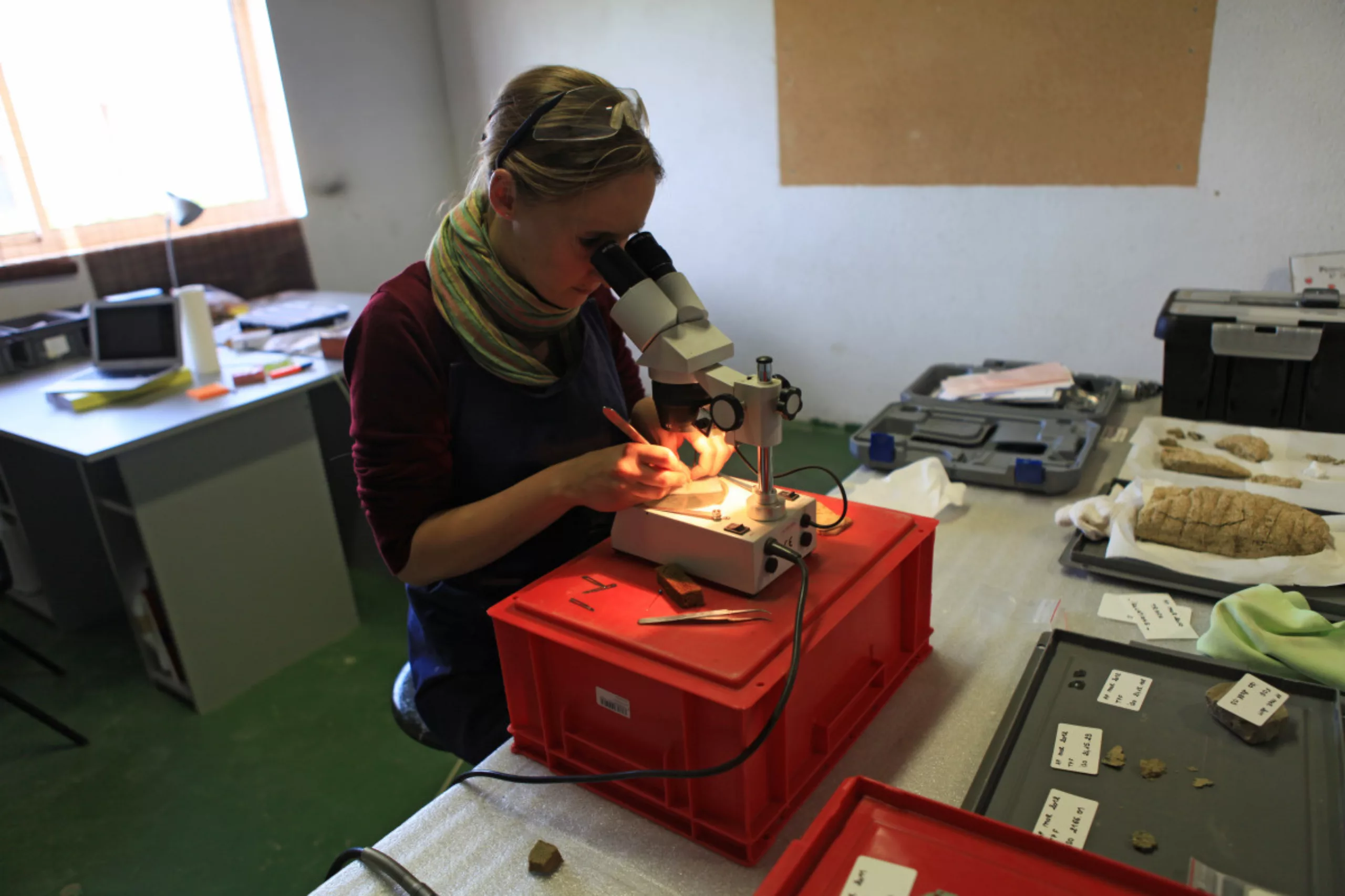
Whether you are a student or a researcher, the museum staff will be happy to welcome you by appointment if you wish to study the collections or consult the reference library.
A unique fund
Drawing on the collection bequeathed by the Semur-en-Auxois Society of Sciences, which co-ordinated and funded the excavations and conservation work at Alésia from 1904 to 2001, and that of the Association for Alésia, our documentary resources continue to grow.
Scientific publications and documentation on the excavations of the siege of 52 BC, the ancient city, the myth of Gallic origins and the pilgrimage of Saint Reine, as well as archaeologists’ archives and unpublished student dissertations, school textbooks and reference editions of Caesar’s Commentaries, are freely accessible at the Alésiathèque, a space open to the public.
Access to the collections and certain documentary holdings is by appointment with the Scientific and Collections Department.
Books
The Alésiathèque houses over 3,500 titles, divided between a scientific and educational library and a heritage collection of rare and antique books.
The majority of the collection consists of open-access scientific publications relating to the archaeological site and the collections at Alésia, the myth of Gallic origins and local history; however, you can also immerse yourself in comic books, documentaries and works of fiction for adults and young people, or come and browse through the “Mémoires de la Commission des Antiquités de la Côte-d’Or”, the “Revue Archéologique de l’Est”, the journal “Gallia”, and all the publications of the Société des sciences historiques et naturelles de Semur-en-Auxois, notably the journal “Pro Alésia” and the “Bulletin”.
The heritage collection (rare or antique works) can be consulted by appointment. Assembled by the Côte-d’Or Department in line with the museum’s scientific and cultural programme, the collection includes, in particular, old editions of “The Gallic Wars”, historical and archaeological textbooks from the past, as well as popular works relating to the cult of Saint Reine and a collection on the controversy surrounding the location of the site of the Battle of Alesia.
archives
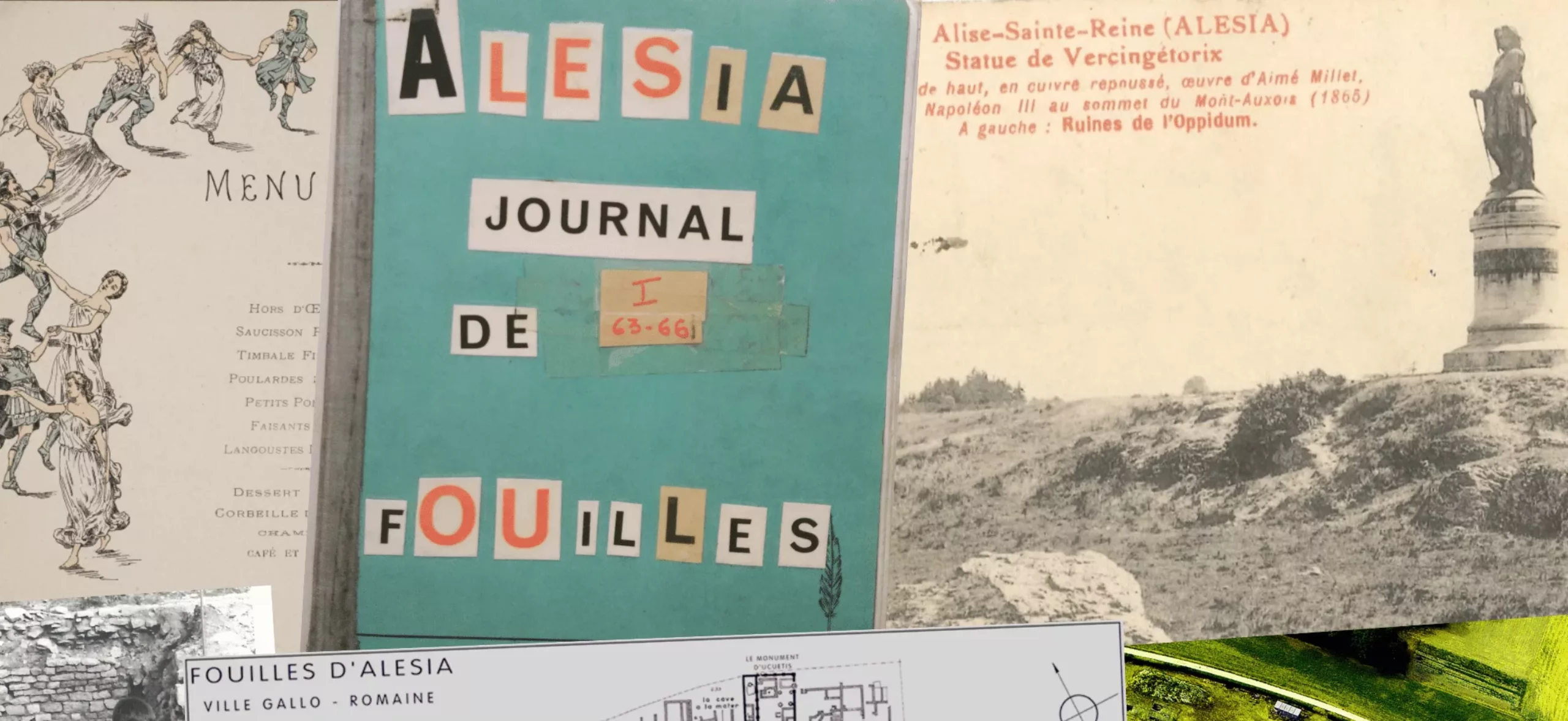
The collection brings together a large part of the archives of the archaeologists and others involved with the site since the early 19th century: correspondence, field notebooks and excavation reports, original plans and drawings…
An overview of the themes and collections available for consultation by appointment:
Excavations from the late 18th century and the first half of the 19th century (Year XII [1803] – 1858)
Former ‘Alésia’ file from the sub-prefecture of Semur-en-Auxois: notarial deeds, correspondence, prefectural decrees
Excavations from the Second Empire onwards
Excavation notebooks and diaries (including student diaries for the 1960s–1970s), official reports and multi-year summaries, drawings, plans, sketches, stratigraphic unit records, inventories of artefacts, film or digital photographs, administrative files, publication proposals
Excavations relating to the siege of 52 BC
- Topographical Commission for the excavations led by the Emperor, later by Colonel Baron Eugène Stoffel, Paul Millot, road surveyor, and Victor Pernet, foreman (1861–1865)
- Semur-en-Auxois Society of Sciences (1905; 1907)
- Abbé Joseph Joly, Abbé Louis Jovignot (1955)
- Hubert Ariente (1965–1966; 1976)
- Joël Le Gall (1971; 1974)
- Michel Mangin, Jacky Bénard (1978)
- Michel Reddé – Siegmar von Schnurbein (1991–1997)
Excavations of the oppidum and the ancient town of Alesia
- Commander Émile Espérandieu: originals returned by the Palais du Roure (Avignon), typewritten transcriptions of part of the collection (1909–1930s)
- Victor Pernet: notes on Alise, field notebooks and diaries, correspondence notebooks (1896–1918); Henri Pernet: field diaries, correspondence (1932–1944)
- Saint-Père Cemetery, the area known as ‘de la Cave 1959’ – Joël Le Gall (1961), based on Marcel Maillard’s diary
- La Fanderolle: south-eastern quarter of the forum, insula H – Joël Le Gall, based on Marcel Maillard’s diary (1955–1958), Michel Mangin (1965–1973), Jacky Bénard (1972–1973), François Didierjean (1973–1974), students (1968–1974)
- In Surelot – Abbé Joly, based on Marcel Maillard’s diary (1956–1958)
- South district, theatre – Robert Sénéchal (1962–1964), Monique Lidôme (1968–1973) – Albéric Olivier, Élisabeth Rabeisen (1976–1987), Michel Mangin, Jacky Bénard, Frédéric Didierjean and students (1977–1978) – INRAP, Stéphane Sindonino (2001–2002) – Archeodunum, François Meylan (2004–2008)
- Temple – Robert Sénéchal (1965–1981)
- Monumental Centre – Jacky Bénard, Charles Weber (1976–1985)
- Belvedere (planned rescue excavation) – Fabienne Creuzenet (1989, collection of articles)
- La Pointe, cave (planned rescue excavation) – Philippe Barral, Martine Joly (1989)
- Ucuetis Monument – Albéric Olivier (1991)
- En Curiot – Fabienne Creuzenet (1991–1997) – INRAP, Stéphane Venault (2007) – Archeodunum, François Eschbach (2014)
- Champs de l’Église – Fabienne Creuzenet (1998–2001) – Anne Delor-Ahü (2002)
- Amphora Cellar – I.N.R.A.P., Jérôme Mercier (2004)
- Les Prés-Hauts – INRAP, Stéphane Venault (2007) – Archeodunum, Yannick Dellea (2009)
- Sanctuary of Apollo Moritasgus – Maurice Tardivon (1931–1932) – Olivier de Cazanove (2008–2018)
Excavations at Merovingian Alesia:
- Basilica of Sainte-Reine and municipal cemetery – Patrice Wahlen (1985–1993)
- Church Fields (necropolis) – Germaine Depierre (1999–2003)
Tourist development of the site and scientific, administrative and personal correspondence
- Visits and official meetings in Alise (1905–1931)
- Correspondence from Louis Matruchot, Jules Toutain and others to Dr Simon, President of the Society of Sciences, and other correspondents (1905–1939)
- Correspondence from Dr Simon, Louis Matruchot, Henri-Gédéon Daloz, Joseph Déchelette and others to Victor Pernet, director of the excavations (1905–1914)
- Correspondence from Jules Toutain, Director of the Alésia Museum and the excavations, notably to Dr Simon, President of the Society of Sciences (1908–1932) and to Mrs Simon (1951–1953)
- Correspondence from Jules Toutain, director of the Alésia Museum and the excavations, to Henri Pernet (1939–1952)
- ‘Municipal Museum’ file (1861–1972)
- Archives of the museum founded by the Semur Society of Sciences in Alise (from 1909)
- Communication materials from the Museum and the Alésia MuséoParc (2010–present)
What you need to know about the archives
Whilst a significant portion of the Alésia excavation archives is now housed at the Alésiathèque, other collections can be consulted elsewhere. For example, the bulk of the Second Empire excavation archives (notably the collection of the Commission for the Topography of Gaul) is housed at the National Archaeology Museum in Saint-Germain-en-Laye; Commander Espérandieu’s archives belong to the Flandreysy-Espérandieu Foundation, at the Palais du Roure in Avignon, whilst it should also be noted that original documentation, some of which has never been published, remains scattered amongst archaeologists and researchers.
Additional collections can be consulted by appointment at the Regional Directorate for Cultural Affairs, Regional Archaeology Service or Historic Monuments Department: excavation reports, classification files, etc. At the Côte-d’Or Departmental Archives in Dijon, various collections can shed light on various aspects of the Alésia site, notably the archives of the Côte-d’Or Antiquities Commission (reference 69 J), René Goguey’s aerial photograph collection (reference 35 Fi 5, accessible with the depositor’s permission) and the cadastral maps. At Bibracte, the European Archaeological Centre, the Deyber collection contains documents on the Roman army and Gallic weapons.
The MuséoParc Alésia accepts donations from archaeologists or their descendants. These original documents, which are often unpublished and fragile, are thus preserved for the long term and made available to researchers and other interested parties (in accordance with the conditions set by the donor or depositor, where applicable).
documentation
A museum’s documentation is the result of the work of several generations of researchers and professionals in the fields of museums and documentation; it is a living body of work that grows and takes shape day by day, year by year. It comprises four sections:
Documentation of the Alésia collections
- Computerised records and descriptions, including lists of bibliographical references and exhibitions;
- Records of restoration and/or preventive conservation work;
- Artwork files for collections acquired since 2002;
- Inventories and statutory stock-taking reports.
Thematic documentation
- Key figures associated with the site (biographies);
- The controversy surrounding the location of the Alesia site;
- Characteristics of the collection: iron and bronze work, bone craftsmanship, Gallo-Roman pottery and glass, white terracotta figurines…
Research theses
Master’s degrees, D.E.A.s or theses, submitted by their authors (access subject to conditions, reproduction prohibited)
Illustrative resources
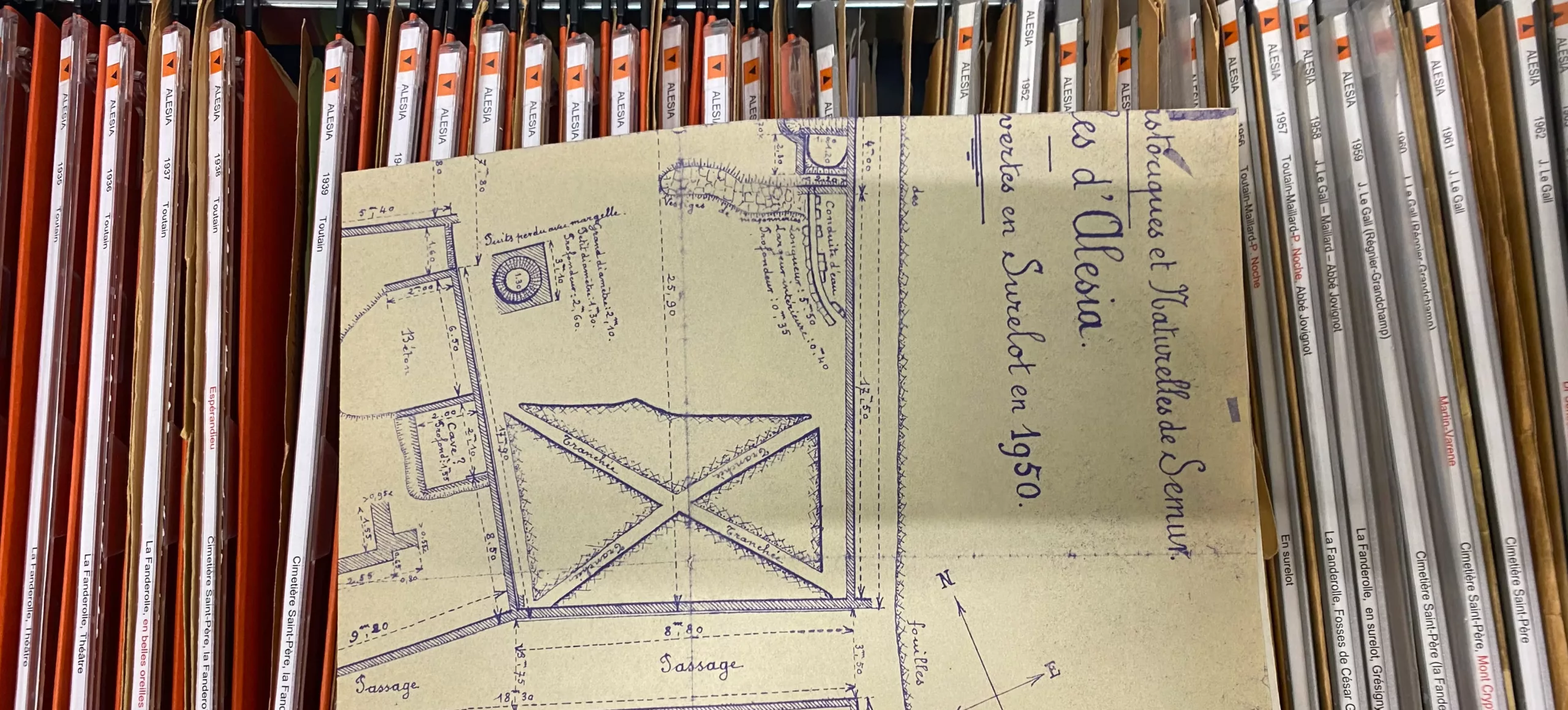
- Collections and archaeological site: working photographs and professional photographs of the collections, photogrammetry (aerial views, 3D views);
- Excavation photographs;
- The cult and pilgrimage of Saint Reine: postcards, devotional images, prints;
- The myth of Gallic origins and the image of the Gaul in advertising and politics;
- Key figures at the Alésia site: portraits of excavation directors and their colleagues, bibliographical notes;
- The village of Alise, past and present: postcards from the Pro Alésia collection, glass plate negatives…
Contact
Science and Collections Department
collections.documentation@alesia.com
03 80 96 96 23
MuséoParc Alésia
1 route des Trois-Ormeaux
21150 ALISE-SAINTE-REINE