Scientific events
Series of archaeological lectures, March–November 2026
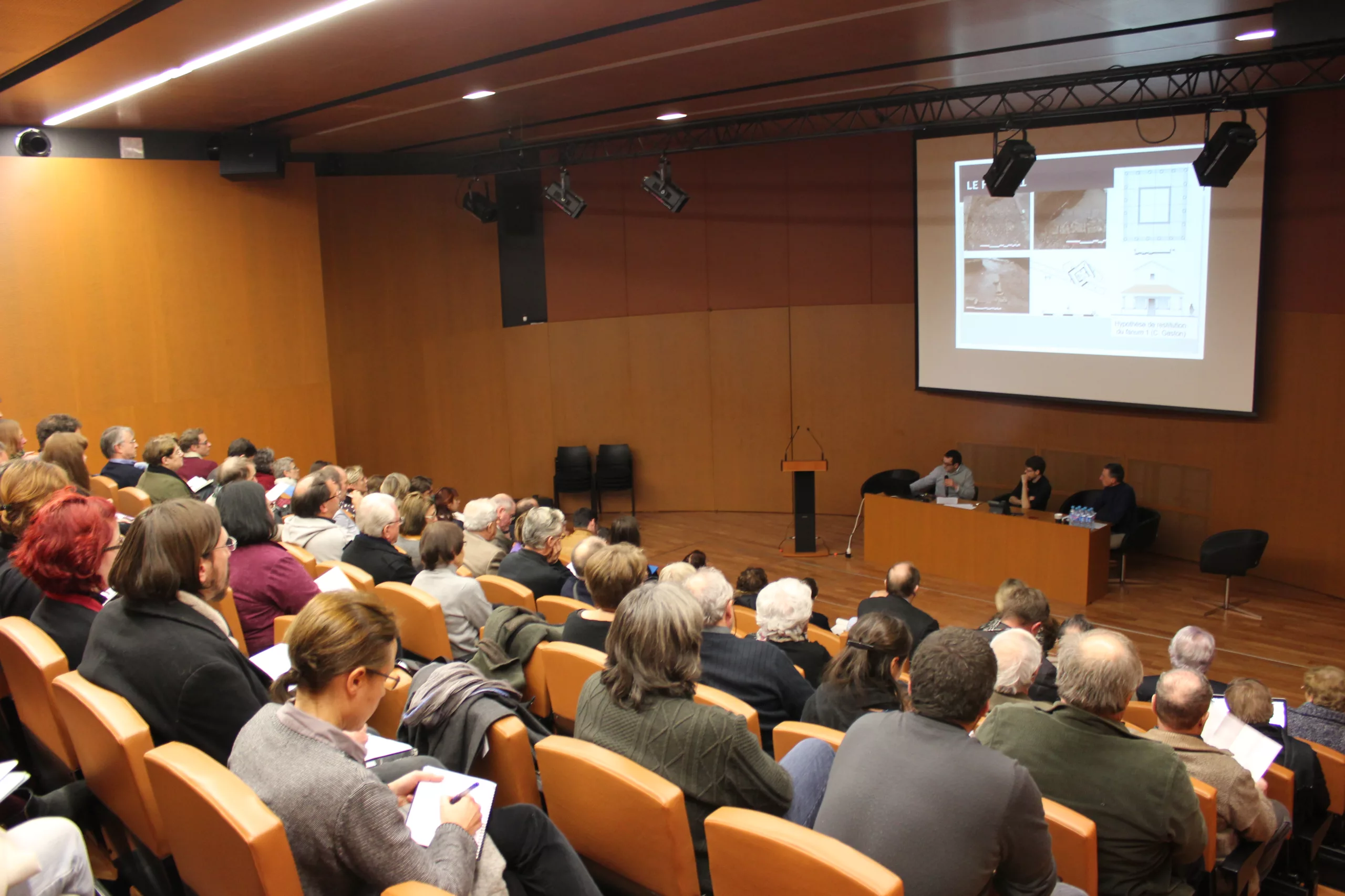
From March 2026, the Semur Society of Sciences (SSS) and the MuséoParc Alésia are joining forces to present a new series of lectures focusing on the latest developments in Gallic and Gallo-Roman archaeology in France.
From March to October, six lectures will mark the season, offering the public the opportunity to discover the latest advances in archaeological research. Aimed at residents of the Côte-d’Or as well as members of the SSS, history enthusiasts, teachers and students, this series is designed to be both scientifically rigorous and accessible to a wide audience.
Guest researchers and specialists will present the main recent discoveries and current issues in archaeology, thereby contributing to a better understanding of Gallic and Gallo-Roman societies.
Beyond its academic programme, this series of lectures builds on the historical link between the Semur Society of Sciences and the Alésia Museum. It also helps to further establish the Alésia site within the network of major French archaeological sites, by affirming its role as a place for the dissemination and sharing of knowledge.
Saturday 28 March at 3.00 pm
The princely burial site at Lavau (Aube) by Bastien Dubuis, archaeologist at INRAP
The tomb of the Celtic prince of Lavau is undoubtedly one of the most significant archaeological discoveries in Europe over the last twenty years. A prominent figure from the Celtic aristocracy was buried there alongside numerous rare and precious artefacts. The speaker, Bastien Dubuis, an archaeologist at INRAP, will guide us through the treasures unearthed in this burial site – treasures which completely transform our understanding of the funerary practices of the great lords of the late Early Iron Age, in the middle of the first millennium BC.
Saturday 18 April at 3.00 pm
The Celtic Principality of Vix and Mont-Lassois (Côte-d’Or) by Bruno Chaume, archaeologist at the CNRS
Situated near Mont-Auxois, Mont-Lassois is one of the most famous sites in Europe for princely settlements from the late Early Iron Age. On 5 January 1953, Maurice Moisson unearthed the ‘mesmerising’ handle of a large bronze cauldron, heralding a major discovery from the Celtic period, now known as the tomb of the Lady of Vix. The last thirty years of research devoted to this Hallstattian principality have made it possible to place this burial within its social context by examining the settlement, the fortification system and the environment in all their forms. Bruno Chaume, an archaeologist at the CNRS, will present the latest discoveries made at the site.
Saturday 23 May at 3.00 pm
The archaeology of the Gallic Wars and Caesar’s account, by Michel Reddé, Emeritus Research Director at the École pratique des Hautes Études
Until recently, independent Gaul was known only through the account given by Caesar during the war of conquest he waged from 58 to 50 BC. Whilst this famous text remains the essential source for tracing the sequence of events, archaeology now enables us to view the proconsul’s account with a different, and sometimes critical, eye. A selection of examples – amongst which, of course, the siege of Alesia features prominently – will illustrate this comparison between one of antiquity’s most famous texts and the reality on the ground, as evidenced by archaeological finds. Booking recommended here
Two further lectures will follow, on Saturday 29 August and Saturday 7 November: these will provide further insight into the excavations carried out over the summer at the oppidum of Alesia, and into an extraordinary Gallo-Roman wooden ceiling discovered in the sanctuary of Apollo at Saint-Martin-au-Val, near Chartres.
Samedi 23 mai à 15h00
L’archéologie de la guerre des Gaules et le récit césarien par Michel Reddé, directeur de recherche émérite à l’École pratique des Hautes Etudes
Jusqu’à une époque récente, la Gaule indépendante n’a été connue que par le tableau qu’en a dressé César à l’occasion de la guerre de conquête qu’il a menée de 58 à 50 avant J.-C. Si ce texte célèbre reste la source incontournable qui permet de suivre le fil des événements, l’archéologie permet aujourd’hui de considérer avec un œil différent, parfois critique, le récit du proconsul. Quelques exemples choisis, parmi lesquels, bien sûr, le siège d’Alésia tient une place de choix, permettront d’illustrer cette confrontation entre l’un des textes les plus célèbres de l’Antiquité et la réalité du terrain, telle qu’on peut l’observer dans le sol. Réservation conseillée ici
Deux autres conférences suivront, les samedi 29 août et 7 novembre : elles permettront d’en savoir plus sur les fouilles faites durant l’été sur l’oppidum d’Alésia, et sur un extraordinaire plafond de bois gallo-romain découvert dans le sanctuaire d’Apollon à Saint-Martin-au-Val, près de Chartres.
Samedi 7 novembre à 10h00
Complexe cultuel antique d’autricum (chartres) : la fontaine monumentale et son plafond de bois par bruno bazin, archéologue et responsable de la programmation scientifique au sein de la Direction de l’archéologie de Chartres métropolE
La réalisation de plusieurs opérations archéologiques entre 1995 et 2006, dans le quartier Saint-Brice situé au sud de la ville de Chartres, a permis d’identifier l’un des plus grands complexes cultuels de la Gaule romaine qui se développe sur une superficie de plus de onze hectares.
Depuis 2006, un programme de recherche est conduit sur ces vestiges d’exception par la Direction de l’archéologie de Chartres métropole avec le soutien du Ministère de la Culture.
Dans l’état actuel des connaissances, cet imposant lieu de culte s’articule autour de deux ensembles architecturaux édifiés en terrasses en direction de L’Eure. Un grand temple à quadriportique prend ainsi place dans la partie ouest. À l’est, c’est un long portique qui se déploie, rythmé par plusieurs édifices dont un possible temple dédié à Apollon, agrémenté d’une fontaine monumentale à 3 bassins. C’est à l’intérieur de cette dernière que plus de 2300 pièces constitutives d’un plafond en bois suspendu ont été retrouvées dans un état de conservation exceptionnelle. La seule comparaison qui soit connue à ce jour pour un même ouvrage de menuiserie se situe en Italie, à Herculanum, dans la maison au relief de Telephus.
À la lumière des deux derniers programmes triennaux de fouilles, cette communication se propose de présenter les différents édifices et aménagements qui constituent cet ensemble religieux remarquable du nord de la Gaule et de faire un point sur l’avancée de la recherche sur le plafond en bois.